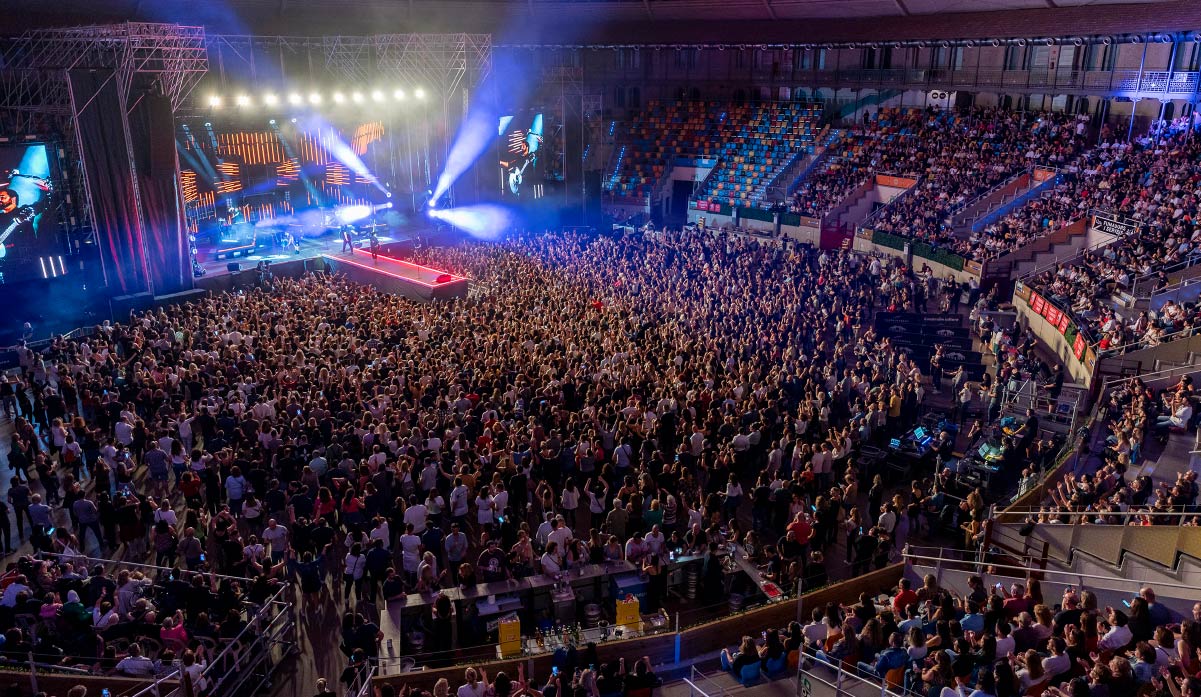
APIC is committed to sustainability in all its activities at the Tarraco Arena, which is the biggest indoor event venue in southern Catalonia (Tarragona).
APIC, the company managing Tarraco Arena, is committed to sustainability in the activities held at the venue. Creast, a company specializing in environmental consulting for the entertainment industry, put the Tarraco Arena's carbon footprint under the microscope during the event held on 3/12/2022
Back in 1987, the Brundtland Commission of the United Nations (UN) defined sustainability as “meeting the needs of the present without compromising the ability of future generations to meet their own needs.”
The methodology from Creast covers the full sustainability cycle – predicting, reducing, measuring, and offsetting – applied to all stages of event production: pre-event, event, and post-event. The emission levels at Tarraco Arena were surprisingly low! Following the GHG – CO2eq measurement protocol and using official emission factors from MITECO, it was found that the venue's energy consumption and environmental impact are well below the average for similar places.
Emission sources were divided into 4 categories: mobility, electricity consumption, catering, and waste.
During the study of these three phases, the energy consumption and its impact looked like this:
Pre-event with 100% electricity consumption and 18.63 kg of CO2 emissions
Event with 56% catering (1086.38 kg CO2), 39% electricity consumption (752.55 kg CO2), 3% waste (61.67 kg CO2), 2% mobility (48.46 kg CO2), totaling 1949.06 kg of CO2 emissions
Post-event with 100% electricity consumption and 1.04 kg of CO2 emissions.
In the report Creast gave us, the good practices that really stand out for event management at Tarraco Arena are the low transport emissions (which is usually a big polluter!) and the reduction of plastic use in catering.
After seeing the event's actual impact, we've offset the emissions generated by planting trees in the planet's lungs: the Amazon.
The Tarraco Arena managers are committed to the environment, and their goal is to keep applying sustainable practices when preparing and running future events.